Residential Painters in Middlesex County MA

Drywall Repair & Surface Prep in Waltham, MA
Are your walls showing cracks, old patches, or water stains? Fresh paint won't fix what's underneath — the walls need to be right first. W&F Painting Solutions handles drywall repair, plaster patching, skim coating, and wallpaper removal in Waltham, Newton, Weston, Lexington, and all of Middlesex County. We work in older homes with original plaster walls every day. Licensed and insured. Free estimates.
Call (781) 392-8341.
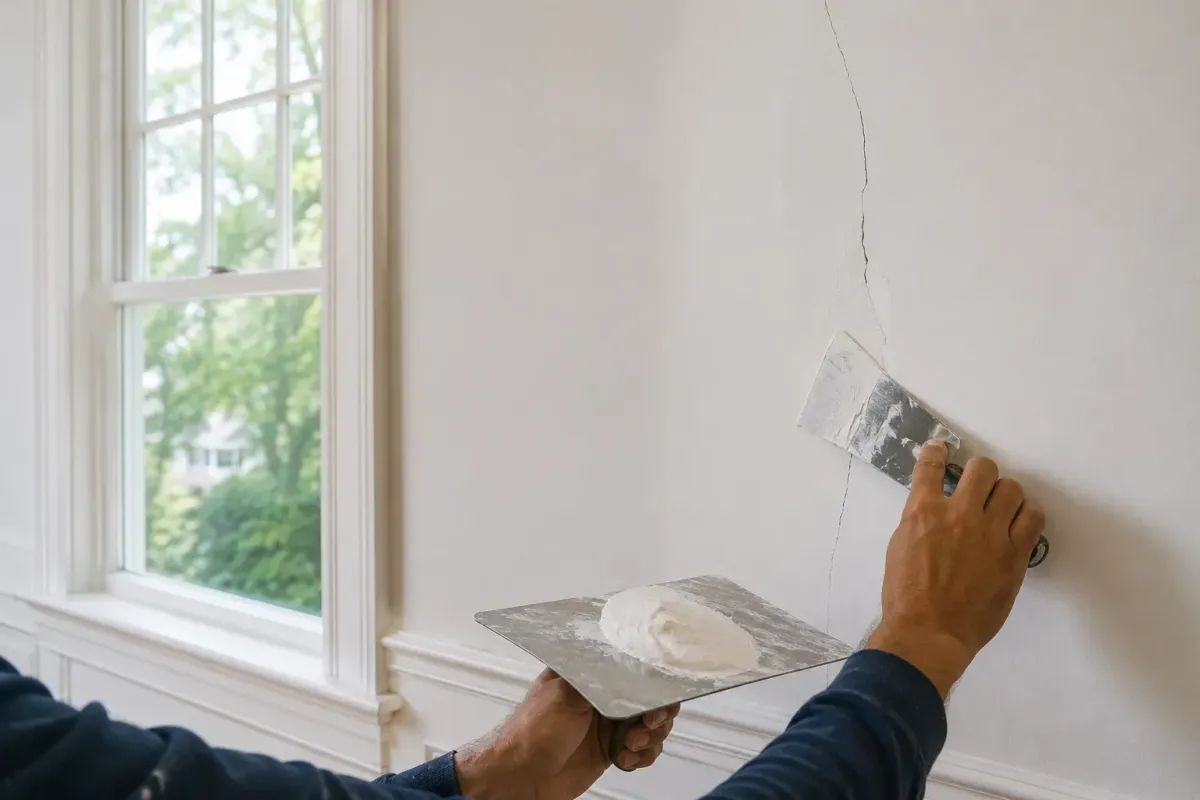
Drywall Repair, Plaster Patching & Surface Prep in Waltham, MA
Fresh paint on bad walls looks worse than old paint on good ones. Cracks show. Patches stand out. Uneven texture catches every bit of raking light. The prep work is what makes a paint job look right — and in older Middlesex County homes, that prep work is often the most important part of the project.
W&F Painting Solutions handles drywall repair, skim coating, plaster patching, and wallpaper removal across Waltham, Newton, Weston, Lexington, and the rest of our service area. We do this work as part of interior painting projects and as standalone jobs for homeowners who need walls fixed before they're ready to paint.
William is on every job. He's worked inside hundreds of older New England homes — colonials with horsehair plaster, triple deckers with layers of old drywall patches, and Weston estate properties where the walls haven't been touched in twenty years. He knows what to look for, how to fix it right, and what it takes for the walls to hold up once the paint goes on.
Drywall Repair
Patches holes, pops, dents, and cracks in drywall walls and ceilings. Feathered flat so repairs disappear under paint.
Plaster Patching
Repairs cracks, holes, and failing sections in original plaster walls. The right approach for older homes — not just drywall compound slapped over plaster.
Skim Coating
Applies a thin finish coat over damaged, textured, or uneven walls. Leaves a flat, smooth surface that takes paint evenly in every light.
Wallpaper Removal
Full removal of wallpaper and adhesive residue, followed by wall repair and priming. Ready for paint when we leave.
Crack & Water Stain Repair
Hairline cracks, settling cracks, and ceiling stains from old leaks. Sealed, primed, and made invisible before any finish coat goes on.
Full Pre-Paint Surface Prep
Getting ready to paint? We handle all wall repair and prep first, so the finish coat goes on clean and lasts the way it should.
Plaster Walls Need a Different Approach Than Drywall
A lot of homes in Weston, Newton, Lexington, and Waltham were built before drywall existed. They have original plaster walls — three-coat lime plaster over wood or metal lath — and those walls behave completely differently than modern drywall. They crack differently. They fail differently. And they need to be repaired differently if you want the fix to actually hold.
The most common mistake on plaster repair is treating it like drywall repair. You can't just fill a plaster crack with joint compound, sand it, and call it done. The crack will come back. Plaster cracks at the surface because something is happening underneath — the lath has shifted, a section has delaminated, or the keys that hold the plaster to the lath have broken. A proper repair addresses the cause, not just the symptom.
William has worked on plaster walls in older Middlesex County homes for over a decade. He knows how to stabilize sections that are pulling away from the lath, how to feather a patch so it disappears completely under paint, and when a section is too far gone to repair and needs to be properly replaced. Older homes are worth doing right. A plaster wall that's been fixed correctly will outlast any drywall patch put over it.
Thinking about painting over those cracks instead? It won't work for long. Hairline cracks in plaster are usually structural — caused by the house settling over time. Paint bridges them temporarily, but they open again, usually within a season. Fix them first, then paint. Call (781) 392-8341 for a free look.
Skim Coating — When the Whole Wall Needs to Start Over
Some walls have had too many patches over too many years. The surface is uneven. Old repairs are visible even after painting. There are layers of texture that don't match the rest of the room. At that point, the right move isn't another patch — it's a skim coat. A full skim coat over the entire wall gives you a fresh, flat surface that takes paint evenly and doesn't betray every repair that came before it.
Skim coating is also the right approach when wallpaper comes down and takes some of the wall surface with it — which happens often in older homes where paper was hung directly over unprimed plaster. After removal, the wall face is torn and uneven. A skim coat restores it. We skim over the damaged surface in thin layers, let each coat cure, sand between coats, and prime before any paint goes on.
It's slower work than patching, and it requires a level of skill that not every painter has. Done right, a skim-coated wall is indistinguishable from new drywall. Done wrong, you can see every trowel mark in the right light. William does this work himself — not a subcontractor — and he's been doing it long enough to know the difference.
Wallpaper Removal in Older Middlesex County Homes
Wallpaper removal is one of those jobs that looks straightforward until it isn't. In newer homes with properly primed drywall, it often goes smoothly. In older homes with plaster walls or unprimed drywall, the paper can bond directly to the wall face — and when it comes off, it takes the surface with it. What looks like a simple removal becomes a skim coat job.
We see this regularly in the older homes across Weston, Newton, and Lexington. A dining room with wallpaper that's been up since the 1970s. A hallway with multiple layers — one over another over another. A bathroom where someone painted over the paper instead of removing it. Every one of those situations requires a different approach, and the wrong approach on plaster walls means damage that takes real work to fix.
When we do wallpaper removal, we score and soak the paper to loosen the adhesive without oversaturating the wall underneath. We remove it in sections, clean the adhesive residue completely, inspect what's beneath, and repair whatever the paper was hiding before priming. Homeowners are often surprised what's under wallpaper that's been up for decades — cracks, old patches, water stains. We deal with all of it before the paint goes on.
Wallpaper over plaster? That's a common situation in pre-1960 homes across Weston, Newton, and Waltham. It needs careful handling. Oversaturating plaster during removal can cause sections to delaminate from the lath. We know how to work slowly and safely. Call (781) 392-8341 before anyone starts steaming old plaster walls.
How We Prep Walls Before Paint Goes On
Every interior painting project at W&F starts with a wall inspection. We're looking for anything that will show through the finish coat — and in older homes, there's usually something. Here's how we work through it.
-
1
Inspect every surface before touching a brush. We walk the room and note cracks, pops, patches, water stains, and any areas where the surface isn't flat. Homeowners are often surprised by how much we find that they've stopped seeing.
-
2
Repair drywall and plaster issues first. Holes patched, nail pops set and covered, cracks opened and filled, failing plaster stabilized. We use the right compound for each surface — not the same product on plaster that we'd use on drywall.
-
3
Sand repairs flat and feather edges. A patch that's proud of the wall surface will show under paint. We sand each repair flush with the surrounding wall and feather the edges so there's no ridge or shadow line when light rakes across it.
-
4
Seal stains and repairs with the right primer. Water stains need a shellac-based stain blocker — standard primer won't hold them. Fresh patches need a high-adhesion primer so the finish coat bonds to the repair the same way it bonds to the rest of the wall.
-
5
Caulk trim and transitions. Where walls meet trim, crown, or baseboards, we caulk before painting. It's the detail that separates a professional finish from a paint job that looks a little off without the homeowner being able to say why.
We don't skip prep to finish faster. Some painters do. You can tell — the patches show in certain light, the cracks come back after six months, the trim gaps open up by the following winter. We take the time because that's what holds up. That's also why our 42+ reviews mention prep work specifically.
What We See Most in Older Middlesex County Homes
The older the home, the more prep it tends to need. That's just how it works. A colonial in Weston that was built in 1935 has been through nearly ninety winters. It's settled. It's had plumbing work done through the walls. It's had wallpaper hung and stripped and painted over. The walls carry that history, and when you put fresh paint on without addressing it, the history shows back through.
The most common issues we find across Newton, Waltham, Lexington, and Weston are hairline cracks in plaster from settling, nail pops in drywall from seasonal expansion and contraction, water stain rings on ceilings from ice dams or old roof leaks, and wallpaper adhesive that was never properly removed before the last paint job. None of those problems are major — but all of them need to be addressed before paint goes on if you want a clean result.
That's the whole reason this page exists. Surface prep isn't a footnote on an interior painting job. It's the job. Paint is the last step — everything before it determines whether the finish looks right and lasts. If you're looking at walls in an older home and wondering whether the prep work really matters, the answer is yes, every time.
Drywall Repair & Surface Prep FAQ
Can you fix plaster walls, or do you only work with drywall?
We work with both. Plaster repair is actually a big part of what we do across Weston, Newton, Lexington, and Waltham — towns where a significant portion of the housing stock still has original plaster walls. Plaster requires different compounds, different techniques, and a better understanding of why it's failing in the first place. We've been doing this in older Middlesex County homes for over a decade and know the difference between a surface fix and a repair that actually holds.
Why do cracks in my plaster walls keep coming back after I've patched them?
Because surface-only patches don't address what's causing the crack. Plaster cracks when the lath beneath shifts, when a section delaminate from the substrate, or when the house continues to settle. If you fill the crack without stabilizing the cause, it opens again — usually within one season. A proper repair involves addressing what's happening underneath the surface, not just filling the gap. That's what we do, and it's why the fix holds after we leave.
Do you do wallpaper removal, or just the painting after?
We handle the full scope — removal, adhesive cleanup, wall repair, priming, and painting. We don't hand you a stripped room and leave you to figure out what's underneath. Wallpaper often hides damage, and in older homes with plaster walls, removal can cause surface damage that needs to be repaired before paint can go on. We deal with all of it as part of one project. Call (781) 392-8341 for a free estimate.
What is skim coating and when do I need it?
Skim coating is applying a very thin layer of joint compound over an entire wall surface to create a flat, smooth finish. You need it when a wall has too much damage or unevenness for individual patches to fix — after wallpaper removal that damaged the wall face, on walls that have had too many layers of repairs over the years, or when you want a completely smooth surface before applying a darker or higher-sheen paint. A well-done skim coat makes a wall look like new drywall.
Can you do drywall repair without painting after?
Yes. We do standalone drywall and plaster repair jobs for homeowners who aren't ready to paint yet, or who plan to paint themselves after the repairs are done. We'll repair, sand, and prime the repaired areas so they're ready for paint whenever you're ready. Just let us know the scope when you reach out.
How do you handle water stains on ceilings?
Water stains have to be sealed with a shellac-based stain blocker before any finish coat goes on — standard primer won't hold them. Even after the leak is fixed, the stain contains minerals and residue that bleed through regular paint, often in the first coat. We seal the stain, confirm the source of the moisture is resolved, and then prime and paint. If the drywall or plaster itself is damaged from the water, we repair that first.
Do you repair walls near Newton Centre, Waltham, or along Route 128?
Yes. We work throughout Waltham, Newton, Weston, Lexington, Belmont, Arlington, Watertown, Cambridge, and all of Middlesex County. Older homes along the Route 128 corridor and the towns just inside it are a big part of what we do. If your home has plaster walls, old wallpaper, or surfaces that have been patched too many times, we've seen it before. Call (781) 392-8341 or get a free estimate online.
How much does drywall repair and surface prep cost in Middlesex County?
It depends on what we find and how much of the wall needs work. A few nail pops and hairline cracks in one room is a different scope than a full wallpaper removal followed by skim coating. We always look at the job before quoting and give you a clear price before any work starts. No surprises on the invoice. Call (781) 392-8341 or fill out the estimate form and we'll schedule a time to take a look.
More From W&F Painting Solutions
W&F Painting Solutions LLC
254 River St, Waltham, MA 02453








Drywall Repair & Surface Prep Across Middlesex County
The older the town, the more prep work tends to be needed — and Middlesex County has some of the oldest residential housing stock in Massachusetts. We work throughout the service area on everything from minor nail pop repairs to full skim coat jobs on plaster walls that haven't been touched in fifty years.
Waltham & Watertown
Dense neighborhoods with a mix of pre-war wood-frame homes and older multi-family properties. Plaster walls, nail pops, and layers of old repairs are common throughout both towns.
Weston & Lincoln
Older estate homes and historic properties with original plaster walls and detailed woodwork. These are the homes that demand the most careful prep work — and where cutting corners shows the most.
Newton & Belmont
Victorian-era colonials and larger pre-war homes with plaster walls throughout. Newton Centre, Newtonville, and Belmont Hill have some of the most repair-intensive interiors we work in.
Lexington & Arlington
Established neighborhoods with traditional colonials and cape-style homes. Lexington's older properties near the town center regularly need plaster repair and skim coating before painting.
Cambridge & Somerville
Triple deckers and attached homes with significant paint and repair history. Wallpaper removal jobs are common in these properties, often revealing surfaces that need skim coating before paint.
Wayland, Maynard & Carlisle
A range of older farmhouses and suburban colonials. Interiors that haven't been refreshed in a decade or more are common — often with multiple layers of wallpaper and old drywall patches to deal with.
What the Prep Work Looks Like Town by Town
Weston & Lincoln — Original Plaster, Estate Properties, and Walls That Need Real Work
These are the towns where we do the most involved prep work. Weston's older colonials, Georgians, and estate properties were built when plaster was the only option, and most of them still have their original three-coat lime plaster walls. The plaster has character — but it also has eighty or ninety years of settling cracks, old repairs layered over one another, and sections where the plaster has pulled away from the lath behind it.
The wallpaper situation in these homes is also its own project. Many Weston homes have dining rooms and hallways with wallpaper that's been up since the 1960s or 1970s, hung directly over unprimed plaster. Taking it off without damaging the wall underneath takes patience and the right technique. We work slowly, score carefully, and deal with whatever the paper is hiding before we prime. By the time paint goes on, the walls are flat, stable, and ready to look the way the house deserves.
Newton & Belmont — Victorian-Era Homes and Layers of Repair History
Newton has some of the most architecturally rich residential housing in Middlesex County — large Victorians, detailed colonials, and multi-family homes with plaster walls throughout. The challenge in these properties is that they've been repaired many times, by many different people, with varying levels of skill. You'll often find patches that were never feathered flat, repairs done with the wrong compound that cracked within a season, and sections where someone painted over a problem instead of fixing it.
Belmont Hill and Belmont Center have similar characteristics — older properties with detailed trim and plaster walls that need real prep before any finish coat goes on. We see a lot of homeowners in Newton and Belmont who've had painters skip the prep and are now dealing with walls where every past repair is visible under certain light. Fixing that properly means going back to the wall, addressing each repair, skim coating where needed, and starting fresh. It's more work up front — and the result holds for years instead of months.
Cambridge & Somerville — Triple Deckers, Wallpaper, and Urban Prep Challenges
Triple deckers in Cambridge and Somerville present a specific set of prep challenges. These homes were built fast and close together, and the interiors have often been updated multiple times by different owners — sometimes carefully, sometimes not. Wallpaper layers are common, particularly in older units that haven't been renovated since the 1980s or 1990s. Some of that wallpaper was hung over other wallpaper. Some was painted over. Getting back to a clean, stable wall surface in these units requires more work than a standard suburban interior.
Drywall repairs from plumbing and electrical work are also very common in triple deckers — access holes that were patched roughly and never properly finished. We see this in a lot of the Cambridge and Somerville units we work in. The patches are there, but they're visible and uneven. We re-do them properly, sand them flat, and make sure they're invisible under the finish coat before we leave.
We Come to You — Drive Times from Waltham
We're based in Waltham off Route 128. Most of our Middlesex County service area is within 20 to 30 minutes on a normal morning. We schedule estimate visits the same week in most cases and can typically start work within a few weeks of a signed estimate.
Weston & Lincoln
15 to 20 minutes via Route 20 west. We're in Weston regularly and know the roads and the housing stock well.
Newton & Belmont
10 to 15 minutes south on Route 128. Newton is one of our most active service towns for interior prep work.
Cambridge & Watertown
15 to 20 minutes via Route 20 or Mt. Auburn Street east. We work in triple deckers and older homes here year-round.
Lexington & Arlington
20 to 25 minutes via Route 2 north. These towns have strong demand for plaster repair in older colonial-style homes.
Wall Repair & Surface Prep Across Middlesex County, MA
Waltham · Watertown · Newton · Belmont · Lexington · Arlington · Weston · Cambridge · Somerville · Jamaica Plain · Wayland · Lincoln · Maynard · Carlisle · Sherborn
What Homeowners Are Saying About Our Prep Work
Serving Waltham and Surrounding Middlesex County Communities
5 Things to Know Before Hiring Someone to Repair Your Walls in Middlesex County
Wall repair and surface prep look deceptively simple from the outside. It's just patching and sanding, right? In practice, the difference between prep work done right and prep work done fast shows up the moment paint goes on. Here's what experienced homeowners across Weston, Newton, and Waltham have learned.
Plaster and drywall are not the same — and the repair approach is different for each
In homes built before the 1950s — which covers most of Weston, Lincoln, Newton, and large parts of Waltham — the walls are likely original plaster, not drywall. Plaster cracks and fails differently, holds moisture differently, and needs different compounds and techniques to repair correctly. A contractor who treats plaster like drywall will produce a patch that looks fine for one season and reopens by the next. Always ask whether the person you're hiring has worked specifically on plaster walls in older New England homes.
Cracks that keep coming back aren't a surface problem
Recurring cracks — especially diagonal cracks near door frames and windows, or horizontal cracks at mid-wall — are usually signs that the substrate is moving. Filling and painting over them is a short-term fix that hides the problem until the next time paint goes on. A proper repair addresses what's causing the crack: loose lath, delaminated plaster, or structural settling. If a contractor patches your cracks without examining why they're there, expect to be doing it again.
Wallpaper over plaster needs especially careful removal
Removing wallpaper from drywall is already messy. Removing it from plaster — especially in homes where the paper was hung without priming the wall first, which was common before 1960 — can pull the plaster surface right off the lath. Oversaturating the wall during removal makes it worse. The right approach is slow: score carefully, apply water or removal solution in controlled amounts, work in small sections, and deal with any surface damage before moving on. Rushing this step means a skim coat job that wasn't in the budget.
Patches that aren't feathered flat will show through paint
This is the most common prep shortcut and the most visible one. A patch that isn't sanded flush with the surrounding wall — or one where the edges aren't feathered gradually into the surface — creates a slight ridge or shadow that shows up under raking light or when paint is applied in a sheen higher than flat. You won't see it until the paint goes on and the room gets natural light. Proper feathering takes time. If your previous paint jobs have patches you can see when the light hits right, this is why.
Water stains and fresh patches need different primers — not standard wall primer
Standard primer won't block water stains. Tannins, minerals, and residue from water damage bleed through it, often showing up after the first finish coat. Water stains need a shellac-based stain blocker — Zinsser BIN is the one most painters who know what they're doing reach for. Fresh drywall patches need a high-adhesion primer so the finish coat bonds to the repair evenly. Using the wrong primer for each situation is how you end up with bleed-through on a brand new paint job.
Painters who say they'll "fix it as they go" without inspecting the walls first. Proper prep starts with a full walkthrough before any work begins. If a contractor isn't walking your walls carefully and noting what needs repair before quoting, they're not planning to address it thoroughly. Surface prep done as an afterthought produces results that look like an afterthought.
W&F starts every interior project with a thorough wall inspection — and William does the prep work himself. He's worked on plaster walls in older Middlesex County homes for over a decade. He knows what to look for, how to fix it correctly, and how to make repairs invisible under paint. Licensed, insured, and on every job. Call (781) 392-8341 or request a free estimate online.
North & Northwest
East & Cambridge Area
About W&F Painting Solutions LLC
W&F Painting Solutions LLC is a locally owned painting company based in Waltham, MA. We work with homeowners and businesses throughout Waltham, Watertown, Newton, and surrounding Middlesex County communities.
Our team focuses on proper prep, organized job sites, and clean, consistent finishes that hold up over time. We’re fully insured in Massachusetts and known for clear communication and reliable scheduling from start to finish.
If you're looking for a professional painter who respects your home and your time, we’re ready to help.
Trusted Painting Professionals Across Middlesex County



Our Office
W&F Painting Solutions LLC
254 River St
Waltham, MA 02453
Phone: (781) 392-8341
Hours:
Monday – Sunday: 7:00 AM – 9:00 PM
Licensed & Insured in Massachusetts
Serving Waltham, Watertown, Weston, Newton, Belmont, Arlington & Lexington


Copyright © 2026 W&F Painting Solutions LLC. All rights reserved.